Daisy Fried
Poet
CLICK ON A BOOK TO PURCHASE A COPY!
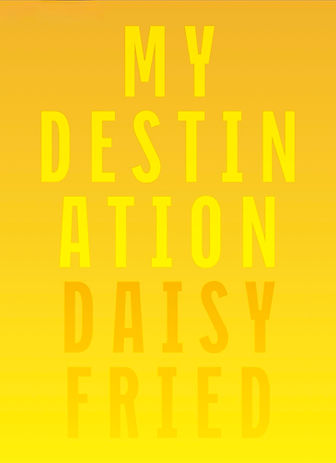
Coming Soon in the US!
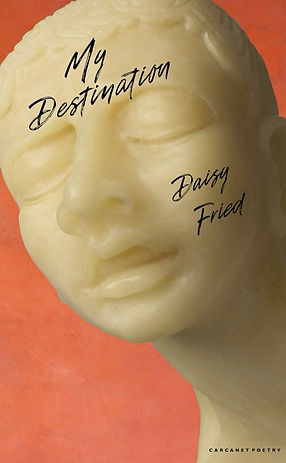
Coming Soon in the UK!


Advance Praise for My Destination (forthcoming October 2026)
When I am reading a poem by Daisy Fried, I often forget that I am reading a poem, and believe myself instead to be experiencing an event. This may be a result of Fried’s effortless command of those aspects of storytelling, like character and action, that we falsely reserve for novelists. But I prefer to think that My Destination succeeds for reasons of poetry – the poet’s unapologetic curiosity about experience, and her remorseless hunger for the right words to know her moment. “I begin to take an interest in life,” she writes at a moment few would dare (this is not the only audacious moment here, far from it). This book quite simply embeds itself in human life, and intriguing new ground is broken, in poems of widowhood, motherhood and more. Fried’s conditions are epic, her voice is human, and her ability to describe the human comedy astonishing. With the tenacity of Athena and the craftiness of Penelope, she makes her way. I admire this book tremendously. Katie Peterson
In My Destination, Daisy Fried writes with unsparing clarity from within grief, desire, motherhood, illness, and public anger. These poems attend closely to bodies, objects, and moments where private life collides with moral and civic force. Restless, comic, and exacting, Fried’s music refuses consolation while insisting on attention—choosing, again and again, not to turn away. Rowan Ricardo Phillips
My Destination, Daisy Fried’s fifth book (and UK debut) explores renewal amid great loss – a struggle as common as rain. As full of lived life as ever, as formally various, and as wide-ranging in both subject and tone, these poems are sophisticated and indecorous, unsentimental and sharp. Fried’s elbows are always out, her gaze unaverted, her treatment of her subject sometimes frontal and sometimes oblique, whether she’s trying to get language to slow things down or make them go faster; to stop change in its tracks or, failing that, to represent with vividness, accuracy, and quizzical attention ‘the shake,’ as Fried writes, ‘between you and me.’
**
Praise for The Year the City Emptied (2022)
There's a lot of fake anger out there, masking dangerous fear. Daisy Fried gives us the real thing: anger born of despair, love, desire, injustice, and loss. She's a grave robber, revivifying the corpse of Baudelaire to mess with him and help her to cope. His ghoulish presence accompanies her as she haunts Philadelphia, 'that old worker,' recording riots, suffering, stench. This book has killer atmosphere, fragrances fine and foul. It growls with the cavernous hunger of our 'graveyard Nation' mid-pandemic. But the calm center of The Year the City Emptied is Fried's dying husband. Just try and read his last lucid words, swansong of a lost world, without choking up. Jennifer Moxley
Fried's voice is brass-tacks, demotic American, with an unsentimental erotic nostalgia—'We couldn't stop being naked'—and a deceptively insouciant outspokenness that both veils and exudes a deep-seated melancholy. David Woo, Poetry Foundation
**
Praise for Women's Poetry: Poems and Advice (2013)
Fried is a poet who will 'tense up' when she hears 'an affirming poem,' finding 'Sourness a kind of joy I try for intricately.' Her present-tense poems vividly record the impressions of our moment...This is a commanding book, and its first and last poems especially stand out: 'Torment,' a biting narrative about narcissistic students, and 'Ask The Poetess,' a hilarious parody of advice columns and the poetry business. New York Times
The title poem in Fried's dazzling new collection begins 'I, too, dislike it. / However,' and skips down a full stanza before completing the line and lavishly describing a tricked-out Nissan G-TR emerging from a garage. The patently masculine sight sparks an unexpected epiphany in the speaker about desire. In the potent blank spaces between 'However' and the rush of the second stanza, Fried displays her gift for honoring hesitation not as a feminine quirk but more as a necessary pause before reaching enlightenment and sometimes even ecstasy. Fried ponders pregnancy, Italian art, frustrating adjunct teaching jobs, Stendahl, and Henry Kissinger. The final section, 'Ask the Poetess: An Advice Column,' shows wit and range worthy of playwright Wendy Wasserstein. Booklist
**
Praise for My Brother is Getting Arrested Again (2006)
The satirical tone here is delicious and the social observation is shrewd. Poetry
Daisy Fried is one not to miss on the poetry scene. Her second collection is evocative and fresh, its poems the kind to provoke and embarrass the elders. . . a voice so original and precise that one wants to read what she's reading and, of course, what she's writing. Her art has room to fly in the face of what's expected and acceptable. Georgia Review
Daisy Fried's poetry is fluid and quicksilver as life seen close up. Here is an original voice: provocative, poignant, and often very funny. Joyce Carol Oates
**
Praise for She Didn't Mean to Do It (2006)
The poems in Daisy Fried's first collection of poetry, She Didn't Mean to Do It, read like tough, urban fables. Formally innovative and thematically challenging, these poems traverse the geography of sex and teenage initiation rights . . . These poems resist being pinned down. They roam the pages in a kind of tight, disruptive free verse. Ploughshares
Daisy Fried's everyday toughness of subject matter makes her all the more aware of tenderness, hence her delight in 'the beauty of boys on skateboards,' with their clean necks, and her feeling for both stabbed and stabber in her poem about the carnival. Maybe this is the book of the year, it has such range and it is so well-written, for her faithfulness to her emotion is matched by her carefulness of execution. Thom Gunn